Technology: pattern testing, live tracking, nozzle research and safety
Aura builds its own tools to put product exactly where it belongs. DropFlight measures our spray patterns, and Aura's X-Bar software tracks every application in real time and paints coverage as we fly. We also develop and test experimental nozzles, and our company collision avoidance system alerts pilots when two Aura aircraft are on a collision course.
Precision Through Pattern Testing & Calibration
At Aura, we don't leave application performance to assumption just to check a box. Every aircraft undergoes pattern testing and calibration to ensure our spray systems are delivering product consistently with uniform distribution across the field.
Using DropFlight, our aerial application analysis platform, we evaluate actual spray patterns collected during controlled test runs. Water-sensitive cards capture individual spray deposits across the swath, which are then scanned and analyzed to measure droplet distribution, coverage, and uniformity. This allows us to identify inconsistencies, evaluate application performance, and make informed adjustments to our equipment and spray systems.
Pattern testing is an ongoing part of our operation, not simply a one-time calibration exercise. We test and evaluate our aircraft periodically and whenever changes to equipment, nozzles, or application configurations warrant verification.
The result is a more measured approach to aerial application, helping us deliver consistent, predictable coverage and get the most out of every application.
Visit DropFlightReal-time tracking and coverage painting
Aura's X-Bar software tracks the aircraft and paints applied coverage on the map as we fly, so every pass is recorded. Customers can watch their application live with a session code from their Aura applicator.
Open live trackingNozzle development and testing
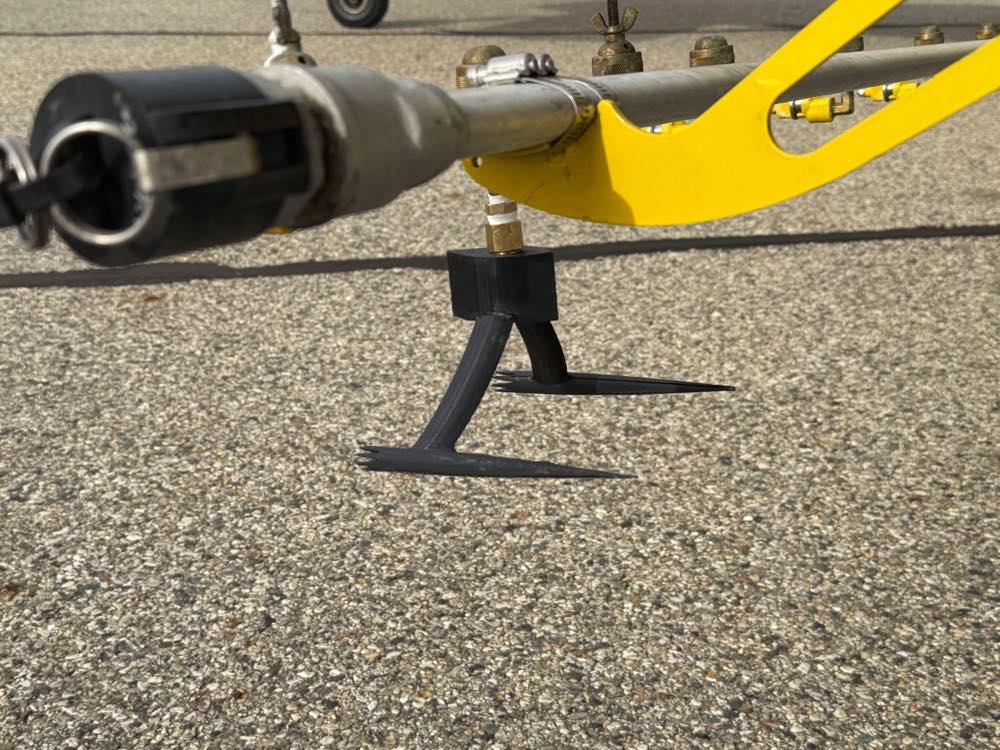
Controlling droplet size is the central challenge in aerial application. Too many fine droplets drift off target, and oversized droplets waste product and leave gaps in coverage. Aura and DropFlight worked on that problem directly, designing and flight-testing experimental nozzles and measuring every result with the DropFlight Pattern Analysis System.
One example is a proof-of-concept straight-stream nozzle we presented at the 2024 NAAA convention in Pattern Testing: Droplet Size Matters. It tests a simple idea: hold the nozzle's exit velocity at a fixed difference from the aircraft's airspeed, so the airstream breaks the liquid into more uniform droplets. One nozzle was flown on our Air Tractor AT-402 (see video) and compared with a standard straight-stream nozzle on single-nozzle passes over water-sensitive cards. The experimental design produced a tighter droplet spectrum (a lower relative span), fewer fine droplets and a more concentrated pattern.
This isn't a production nozzle. It needs boom pressures of roughly 400 to 600 PSI and a smaller-than-practical orifice. This nozzle is a research platform rather than a field-ready part. It shows how we work: test new ideas, make improvements and push for a better application for our customers.
Company Collision Avoidance
Think of it as TCAS built for our own fleet. Every Aura aircraft shares its GPS position, and the system continuously projects where each one is headed. If two of our aircraft end up on a collision course, both pilots hear an audible traffic alert that calls out where the other aircraft is.
The system then gives deconfliction advisories, such as telling one pilot to turn while the other holds course, so both crews know how the conflict will be resolved before it gets close. It's built for the way agricultural aircraft actually work: low, fast and often in the same block of fields.
It doesn't replace see-and-avoid or radio calls. It adds to them, giving every pilot better situational awareness whenever more than one Aura aircraft is working an area.